
Pulse converters
Обзор
The pulse converter is available in three versions:
- SICLOCK PCON
- SICLOCK EOPC
- SICLOCK GPS1000 PS

SICLOCK GPS1000 PS, SICLOCK PCON and SICLOCK EOPC pulse converters
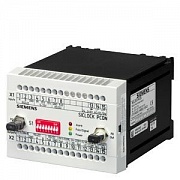
SICLOCK PCON pulse converter
The SICLOCK PCON is a single-channel, electrical-optical pulse converter. It enables electrical and optical time frames and pulses to be distributed.
The device has three inputs for electrical signals (RS 422, RS 232, etc.), one optical input, as well as five electrical outputs and one optical output. By using fiber-optic cables, longer distances can be bridged with very high interference immunity.
The SICLOCK PCON pulse converter can be operated in two modes:
- In transparent mode, the input signal is output at all outputs without any change.
- In pulse mode, an edge change at the input triggers a pulse with parameterizable length at all outputs.
The device is easily parameterized by means of DIP switches located directly on the device.
Inputs X1 | Outputs X2 |
RS 422 (non-isolated) | RS 422 (non-isolated) |
RS 232 (non-isolated) | RS 232 (non-isolated) |
Pulse input 5 ... 35 V or 5 ... 70 V | Pulse output 24 V (non-isolated) |
Pulse output 24 ... 220 V (isolated) | |
FOC | FOC |
BFOC connection system | BFOC connection system |
TTY 20 mA current interface |

SICLOCK PCON pulse converter (functional diagram)
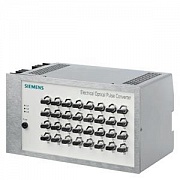
SICLOCK EOPC pulse converter
The SICLOCK EOPC is an electrical-optical converter and hub. It features two electrical inputs, which can be alternatively used, and transfers these signals at its 32 fiber-optic outputs. This pulse converter is therefore the ideal choice for applications with numerous nodes with optical pulse interface which have to be synchronized.
Inputs X1 | Outputs |
TTY 20 mA current interface | 32 x BFOC 62.5/125 µm |
Pulse input 10 ... 65 V |
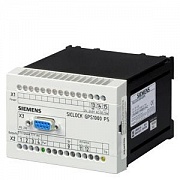
SICLOCK GPS1000 PS pulse converter
The SICLOCK GPS1000 PS pulse converter is always used when a SICLOCK wireless receiver is used as stand-alone unit, i.e. without a central plant clock. It fulfills two main functions:
- On the one hand, the pulse converter is used as an energy source for SICLOCK wireless receivers.
- On the other hand, the device is used as a level converter.
The time signal received at input 11/12 is output as RS 232 level at the Sub-D interface X3.
Inputs | Outputs |
TTY 20 mA current interface to the wireless receiver | 9‑pole Sub-D RS 232 level |
TTY 20 mA current interface | |
TTY-inverted 20 mA current interface |